

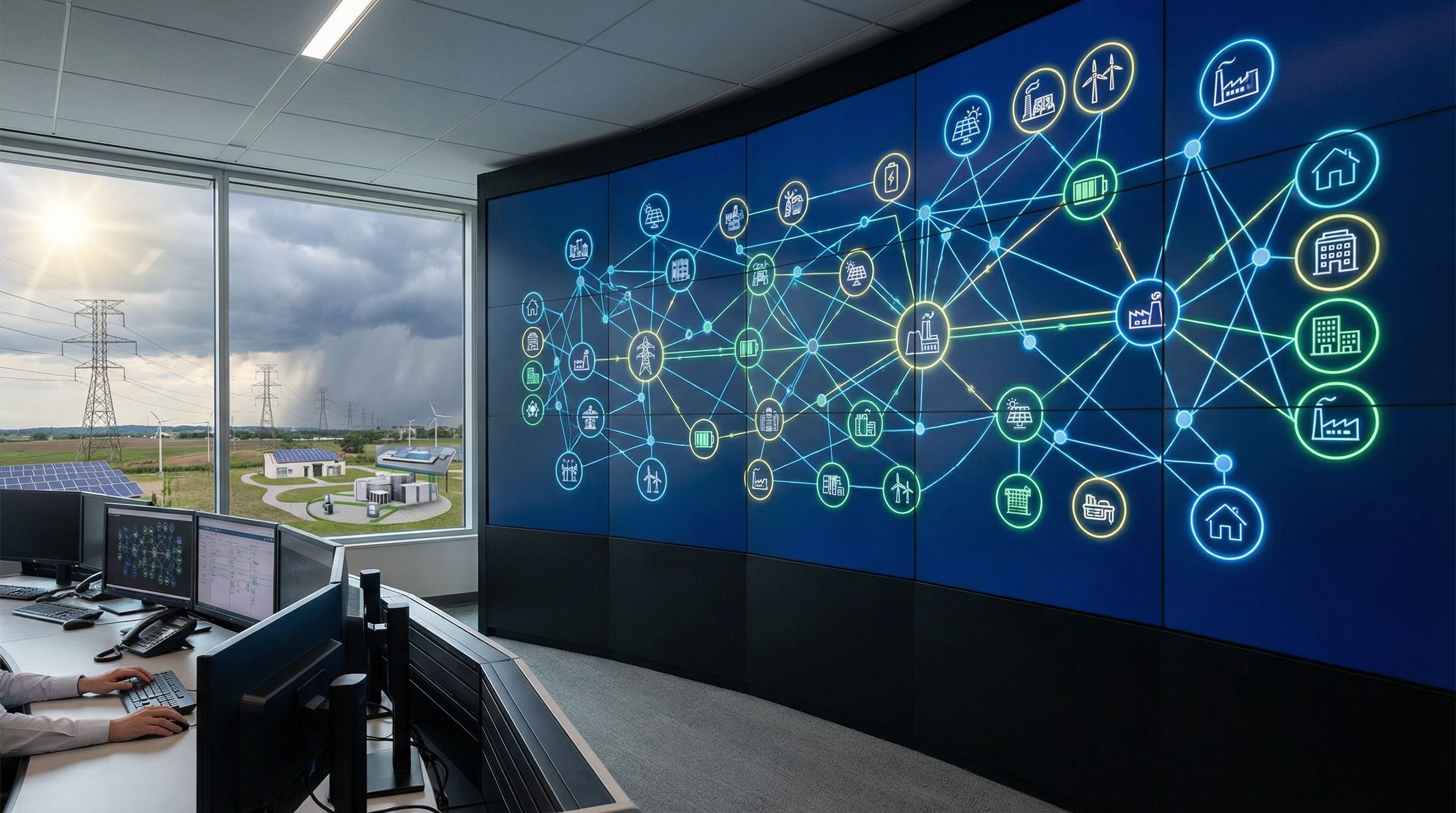
In today’s rapidly evolving energy landscape, utilities are contending with a distribution grid that’s no longer designed for predictability. The rise of distributed energy resources (DERs), electric vehicles (EVs), flexible loads, and new market players has upended the traditional one-way flow of electricity. What was once a centralized, utility-controlled infrastructure has transformed into a complex, decentralized web of assets and actors—each with their own goals, behaviors, and technical constraints.
To navigate this complexity, utilities must rethink how they plan, operate, and interact within the grid. The answer is not to wrest back control, but to orchestrate it—with precision, coordination, and adaptability.
The Chaos Factor: DERs, EVs, and the Demand Surge
According to IEA (International Energy Agency) global electricity demand is projected to continue to increase at a rate of about 4% for 2025. Growth is primarily coming from emerging economies like China and India with steady growth in the US and Europe.
Most of the growth is largely attributed to the building of new data centers, transportation electrification, and new industrial loads.
- Industry alone accounted for 30% of global energy use in 2022 (IEA)
- Data center power demand is expected to grow 160% by 2030 (Goldman Sachs)
- EVs adoption continues its steep Trajectory with 17 million sold globally in 2024 – a staggering 25% increase year-over-year (IEA Global EV Outlook, May 2025)
Compounding the issue is the explosive growth of small-scale renewables, which is not only transforming the energy mix but also injecting greater variability and complexity into grid operations.
- In March 2025, renewables surpassed fossil fuels in U.S. electricity generation for the first time, dropping fossil sources to 49.2% of the mix (IRENA & U.S. DOE)
- Globally, distributed solar and wind have surged to make up 11.7% of the total electricity mix, contributing to 29.1% renewable share worldwide (IRENA, 2024)
While these figures mark progress on decarbonization, they also bring new operational challenges for utilities. The distribution grid—once designed for one-way, centralized flows—must now manage:
- Variable generation that fluctuates with weather and daylight
- Two-way energy flows from rooftop solar, EV batteries, and prosumers
- Fragmented control systems and asset ownership structures, which limit visibility and coordination.
Together, these dynamics are straining the ability of utilities to maintain reliability, predictability, and grid stability—forcing a shift from static infrastructure to dynamic orchestration.
Control Requires Coordination
Utilities today are not just stewards of infrastructure—they are orchestrators of a highly distributed and dynamic system. Achieving stability in this environment requires a shift from centralized command-and-control models to a more collaborative and data-informed architecture. This involves:
- Leveraging real-time data to enable proactive and adaptive operational strategies.
- Fostering interoperability across systems, devices, and stakeholders.
- Moving from static rulesets to dynamic orchestration engines that balance multiple objectives.
- Improving visibility at the grid edge to detect, monitor, and steer DER behavior.
As highlighted in the Optimizing the Energy Grid white paper from Nokia, Dell Technologies, and Enscryb, flexibility is no longer optional—it’s fundamental. But flexibility without orchestration risks disorder. What’s needed is a systematic way to simulate, validate, and coordinate resource behavior across a diverse ecosystem of actors.
From Simulation to Orchestration: A New Operational Mindset
Simulation and digital twin technology offer utilities a way to understand, test, and plan for multiple futures. By creating data-driven replicas of their networks - complete with virtual representations of assets, market signals, and load profiles - utilities can model scenarios such as peak demand events, DER integration, and market participation without risk to live operations.
Once validated, these simulated configurations can then be operationalized through intelligent orchestration platforms that automate real-time decision-making across the network. This approach enables:
- Granular demand-side flexibility through dynamic load shifting.
- Asset-level coordination for voltage and frequency support.
- Market alignment with pricing and programmatic participation.
- Contingency planning for outages, weather events, or cybersecurity threats.
By adopting this simulation-to-orchestration loop, utilities can shift from reactive control to predictive optimization - an approach essential for resilience in a multi-stakeholder grid.
Best Practices for a More Controllable Future
To regain control without centralization, utilities should consider these guiding principles:
- Model the Grid Before You Operate It Use simulation tools to forecast system behavior, identify constraints, and test operational scenarios.
- Deploy Edge Intelligence Push analytics and decision-making closer to the grid edge to reduce latency and improve responsiveness.
- Automate, But with Oversight Enable real-time orchestration of DERs, but retain human-in-the-loop supervision to ensure accountability and adaptability.
- Integrate Across Domains Break down IT/OT silos and foster cross-functional coordination between engineering, operations, and planning.
- Prepare for Market Integration Design systems and data models that support flexible participation in demand response, balancing, and ancillary services markets.
Final Thought: Orchestration Is the New Control
Control in a modern grid no longer means dictating every action - it means enabling coordinated autonomy across thousands of actors and assets. In this distributed and demand-driven future, success will be defined not by how much a utility can command, but by how well it can orchestrate.
Simulation and orchestration are no longer aspirational - they are essential. By embracing them, utilities can manage the unpredictable, operate with confidence, and lead the energy transition from the edge up.